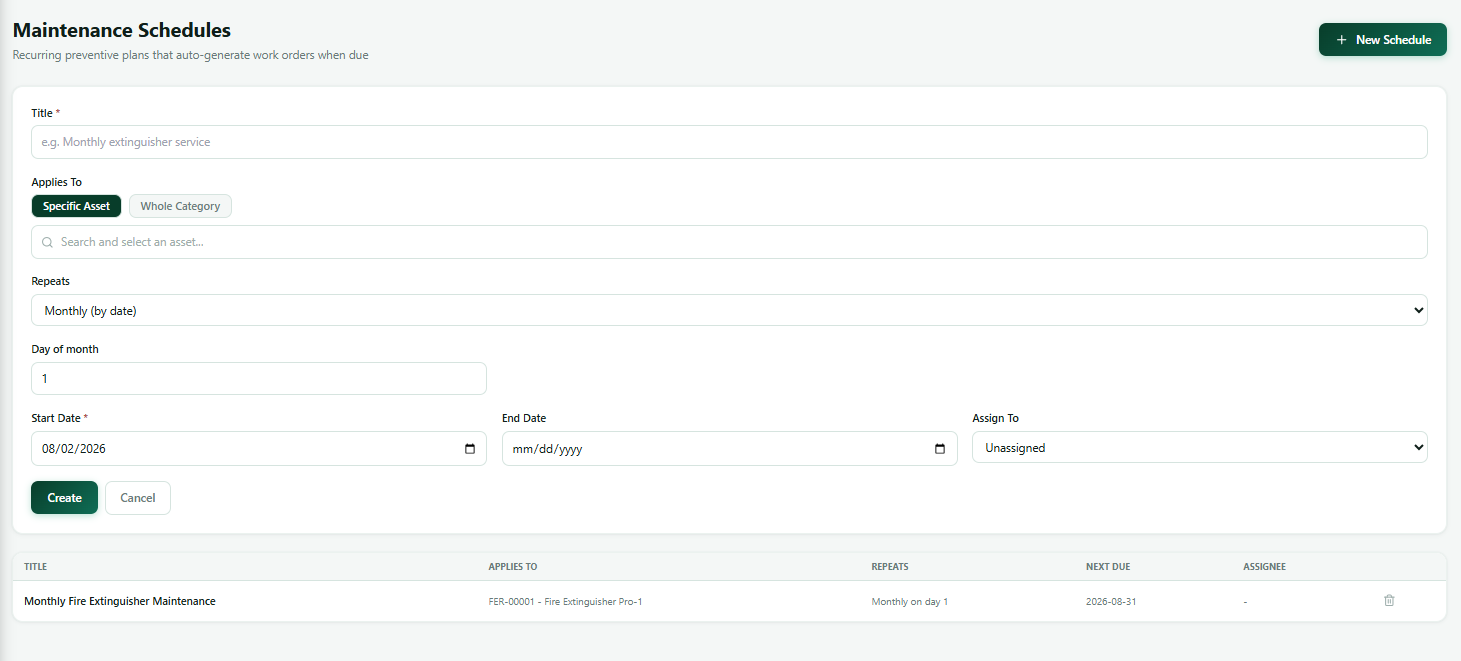
Set the recurrence once and the schedule generates the work orders. Every job is linked to a real asset, so the equipment history builds itself as you go.
Preventive maintenance is a discipline problem long before it is a software problem. Everybody knows the pump needs servicing every three months. Whether it actually gets serviced every three months depends on whether somebody remembers in the middle of a week where three other things broke. Nexora Maintenance takes the remembering away. You define the recurrence against the asset, and the scheduling engine generates the work orders on time, every time, whether anyone was thinking about it or not. Each job is tied to a specific piece of equipment from the shared asset register, so the maintenance history accumulates against the machine rather than in somebody’s head.
The problem today
The maintenance plan is a spreadsheet with dates in it, and one person keeps it. When that person is on leave, the plan is on leave. When they leave the company, a surprising amount of institutional knowledge walks out with them, because half the plan was never really in the spreadsheet, it was in their memory of which machines need watching.
Jobs get done and recorded on paper, or not recorded at all. The record, where it exists, says the work was carried out. It rarely says against which specific unit, so the same identification problem that ruins inspection records ruins maintenance records too. Three years of servicing exists and none of it can tell you which of your four identical pumps is the troublesome one.
Then the annual budget conversation arrives and somebody asks whether to keep repairing a machine or replace it. There is no history to answer with, so the answer comes down to who argues best.
Recurring schedules
Define the recurrence against the asset once. The engine generates the work orders from then on.
Automatic generation
The scheduler runs on its own. Nobody has to remember, and nobody has to maintain a spreadsheet of dates.
Every job linked to an asset
Work orders point at a specific unit from the shared register, so history builds per machine rather than per description.
Scan to job
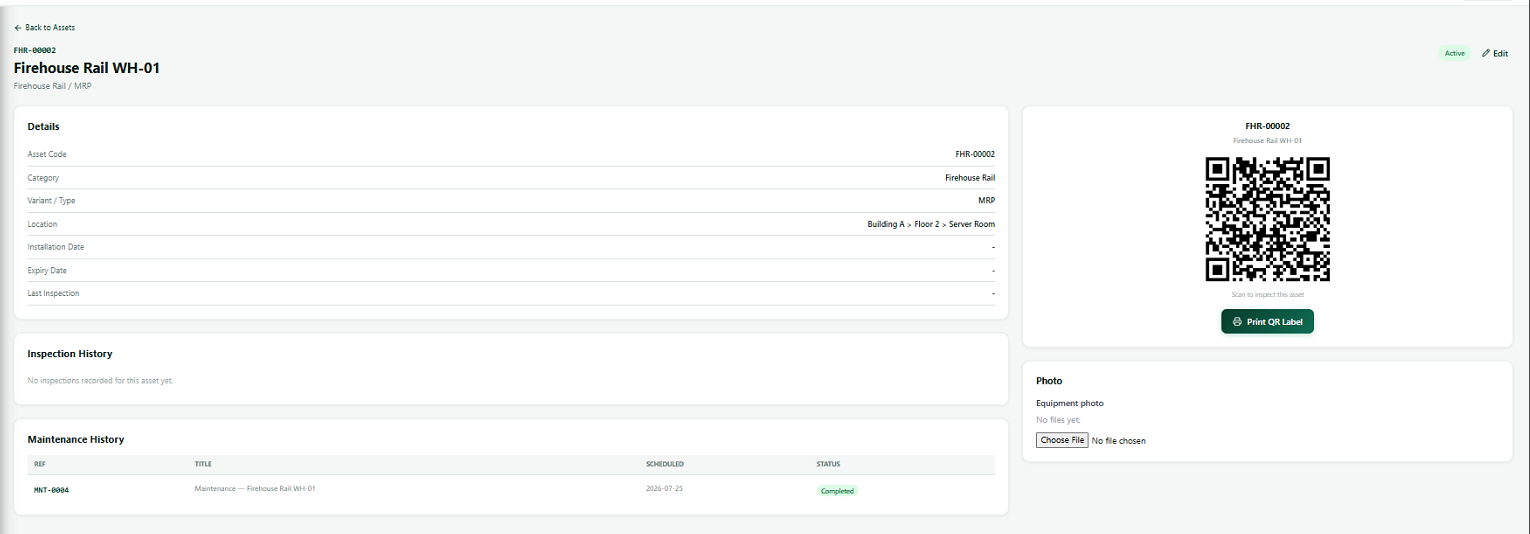
Scan the QR tag on the equipment in the field and raise or open the job against that exact asset.
Ad hoc work orders too
Not everything is scheduled. Raise a one off work order whenever you need one, against the same asset register.
History on the asset page
Any asset shows its full maintenance history alongside its inspection history, in one view.
The schedule does the remembering
You define what needs doing, against which asset, and how often. The recurrence engine takes it from there and generates the work orders as they come due. That shift is smaller in software terms and larger in practice than it sounds. A maintenance plan that depends on a person checking a spreadsheet is a plan that degrades quietly whenever that person is busy, and the degradation is invisible until something fails. A plan that generates its own work is either being done or visibly not being done, and both of those are better than not knowing. It also means the plan survives staff changes. The knowledge is in the system rather than in the head of the person who set it up.
Every job points at a real machine
Work orders link to assets in the shared register, which is the same register the safety team uses for inspections. That link is what turns individual jobs into a history. Open any asset and you see its maintenance history and its inspection history together. That single view is what a manager needs to make a repair or replace decision, and it is nearly impossible to assemble in a spreadsheet based process, because the underlying records never pointed at a specific unit in the first place.
Raise a job from the equipment itself
Scan the QR tag on the machine and raise or open a job against that exact asset. No searching a list, no picking the wrong unit from four identical entries, no writing a note to type up later. The practical effect is that jobs get raised at the moment somebody notices something, standing in front of it, rather than at the end of the day when three of the four things they meant to raise have been forgotten.
Ad hoc work when you need it
Not everything is on a schedule. A one off work order can be raised at any time against the same asset register, so unplanned work still lands in the same place with the same links and shows up in the same history.
We should be clear about the boundary here, because it matters when you are comparing systems. This module today is built around planned and preventive work and one off jobs. A full breakdown and corrective maintenance workflow, with fault reporting, technician assignment, downtime start and stop, and downtime cost on a dashboard, is on our roadmap and is not in the product now. Spare parts inventory is not planned in the near term either. If breakdown workflow is the thing you are buying for, say so early and we will tell you honestly where we are.
How maintenance work is generated and done
The scheduled path and the ad hoc path, both landing in the same place against the same asset.
What gets recorded
Work order reference. The asset it relates to, from the shared register. What the work is. Whether it came from a schedule or was raised ad hoc. Who it is assigned to. Status through to completion. Timing. Attachments. Everything attached permanently to the asset so its history accumulates.
What the manager sees
Work orders outstanding and who is carrying them. What is coming due. Which assets consume the most maintenance work. On any asset, the complete maintenance and inspection history in one view. The evidence needed for a repair or replace decision, taken from your own records rather than from opinion.
Not today. The module covers planned and preventive work and ad hoc jobs. A full breakdown workflow with downtime tracking is on our roadmap and we would rather tell you now.
Is there spare parts inventory?
No, and it is not close on the roadmap. If parts inventory is essential to you, tell us early rather than late.
Can technicians raise jobs from the field?
Yes. Scanning the QR tag on the equipment opens the maintenance flow against that exact asset.
How do schedules survive somebody leaving?
They live in the system rather than in a spreadsheet on one person’s machine. That is much of the point.
Can we import our existing maintenance plan?
Your equipment list can be imported as part of setup. Talk to us about your specific plan format in a demo and we will be straight about what transfers cleanly.
See a schedule raise its own work
We will set up a recurrence against one of your asset types and show the whole path to history.
We use cookies to run this site and, with your consent, to understand how it's used. Strictly necessary cookies are always on. Read our
Cookie Policy and
Privacy Policy.
Cookie preferences
Choose which categories of cookies we can use. You can change this at any time from the link in the footer.