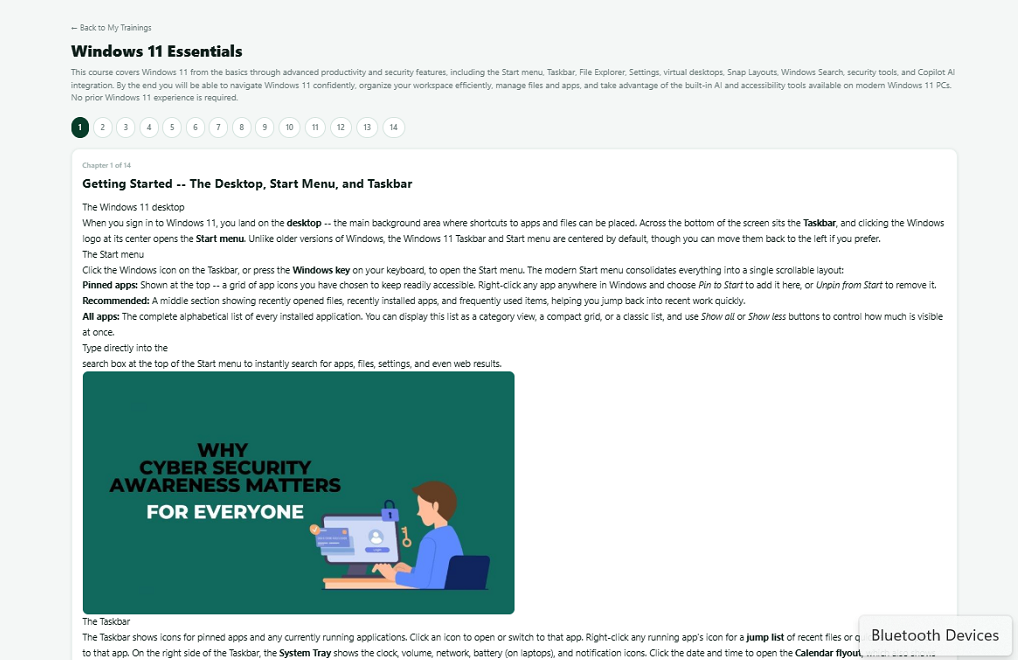
Most learning platforms are built for selling courses to the public. This one is built for the far less glamorous job of proving that the people on your site are competent to do what they are doing. That means different things matter. Exams have to be genuinely secure. Certificates have to be verifiable by an outsider, because your client’s auditor is not going to take a PDF at face value. Recertification has to chase itself, because a certificate that expired in March and was noticed in November is the same as never having had it. Nexora Training is shaped around those requirements rather than around course sales.
The training matrix is a spreadsheet with names down the side and courses across the top, and a colour code that one person understands. Certificates are PDFs in a folder, or paper in a filing cabinet, or in a few honest cases photographs of paper certificates taken on a phone.
Expiry is the part that fails hardest. The matrix has expiry dates in it, and nothing looks at them. Somebody spots a lapsed certificate when they happen to scroll past that row, which is usually when an auditor is already in the building. By then it is not a training problem, it is a finding.
Then a client asks for proof that the four people coming to their site are certified. You send PDFs. They have no way of telling whether the PDF is real, because a PDF is just a picture of a claim. Anyone with basic software could produce a convincing one in ten minutes, and everybody involved in that exchange knows it.

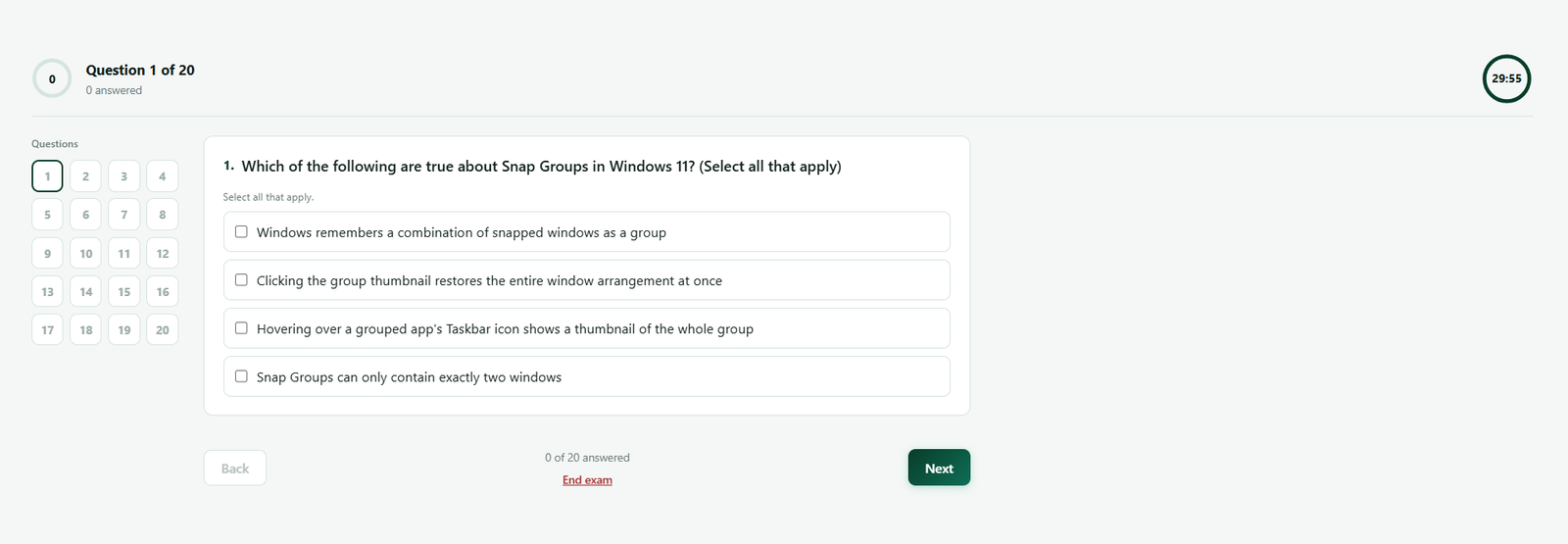
Exams draw from question pools and present one question per page, with the answers graded on the server. During an attempt, the correct answers are never sent to the browser at all. That is worth stating precisely, because a great many training platforms send the whole question object including the answer flag down to the page and simply hide it in the interface. Anyone curious enough to open the developer tools can read the paper. Question pools mean two people sitting next to each other are not looking at the same questions in the same order. Questions can carry images, which matters for anything where the competence being tested is visual, such as identifying a defect or reading a sign. Learners can retake where you allow it, and administrators can reset attempts when there is a good reason. Both are recorded.
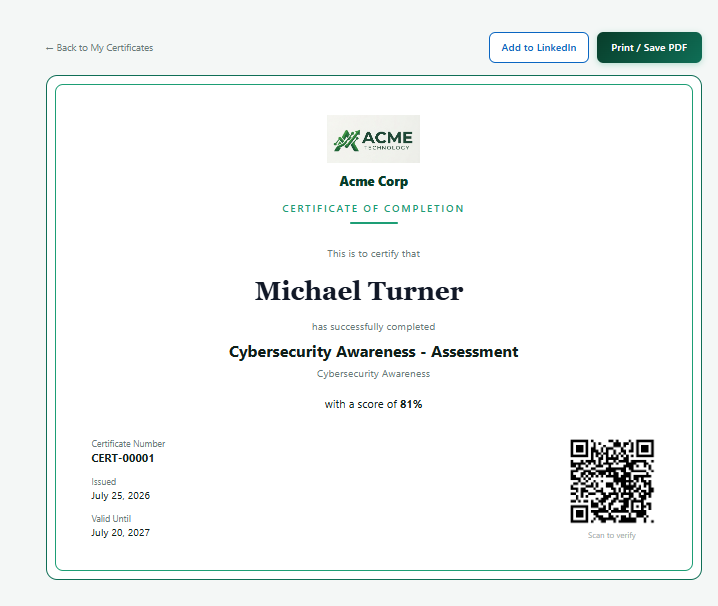
On completion the system issues a certificate, and every certificate carries a public verification link. Someone outside your company follows the link and confirms the certificate is genuine, with no login and no account. That single feature changes the conversation with clients and auditors. Instead of sending a PDF that proves nothing and hoping, you send something checkable. It also protects you in the other direction, because a certificate that can be verified is a certificate that cannot be quietly forged by somebody trying to get on site.
A learning path is an ordered set of courses where later ones stay locked until their prerequisites are complete. The unlock state is calculated live from actual completions rather than stored as a flag, which means it cannot drift out of step with reality. Compliance and recertification tracking runs underneath. The system knows who is due, who is overdue, and reminds them. That is the piece that turns a matrix from a record of the past into something that manages the future.
Two routes in. The first is your own material: upload a training PDF you already own and the system splits it into chapters, so material that exists as a document becomes a course quickly rather than being retyped by somebody’s assistant. The second is our library. ApexGenTech maintains a set of ready courses. When you adopt one, you get your own private copy that is yours to edit. If we later update the master, you are notified rather than overwritten, so an edited course is never silently replaced with our version. One thing we want to say plainly: safety course content is written by people who know the subject. None of it is machine generated. In a field where getting the content wrong can hurt somebody, that is not a small distinction.